

Electric mobility is a well-established reality that is driving the transformation of the automotive sector, which is moving towards ever greater energy efficiency, new technical solutions, and more sustainable practices.
In this context, ICC is ready to take on the challenge thanks to its ICCxEV® cable line, designed to support every stage of energy transfer in electric vehicles, from charging stations to on-board systems. This cable type is also built to withstand harsh conditions of use thanks to its compliance with the highest quality and safety standards.
EV CHARGING CABLES
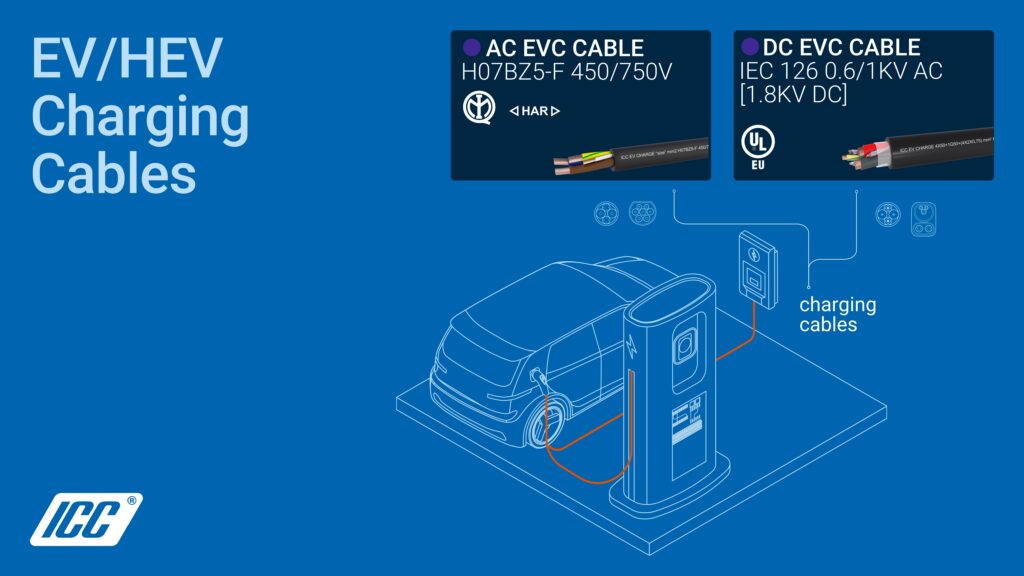
Alternating Current (AC) Charging – Mode 3
The most common charging mode for electric vehicles (known as “slow charging”), compliant with the CEI EN 61851-1 standard. This mode involves the connection to electric charging stations or wall boxes (EVSE) using alternating current (AC).
Our AC EVC H07BZ5-F cable is specifically designed for this type of charging:
- Nominal voltage: 450/750V – Operating temperature: -35°C / +90°C
- Halogen-free rubber and polyurethane insulation/sheathing
- Suitable for both fixed and dynamic installation
- Suitable for outdoor environments, even in the presence of chemicals, sunlight, or water
Direct Current (DC) Charging – Mode 4
The fastest and most powerful solution, allowing “fast charging” via Direct Current (DC). A very useful system for stations on motorways and in suburban areas, capable of guaranteeing partial charging in just a few minutes.
The DC EVC Cable IEC 126 is UL EU certified and complies with the IEC 62893-4-1 standard:
- Nominal voltage: AC 0.6/1kV (1.2kV) – DC 0.9/1.5kV (1.8kV) – Operating temperature: -25°C / +90°C
- Rubber insulation, polyurethane sheath, halogen-free
- Suitable for both fixed and dynamic installation
- Suitable for outdoor environments, high resistance to UV rays, oils, and chemicals, flame retardant
Charging stations internal wires
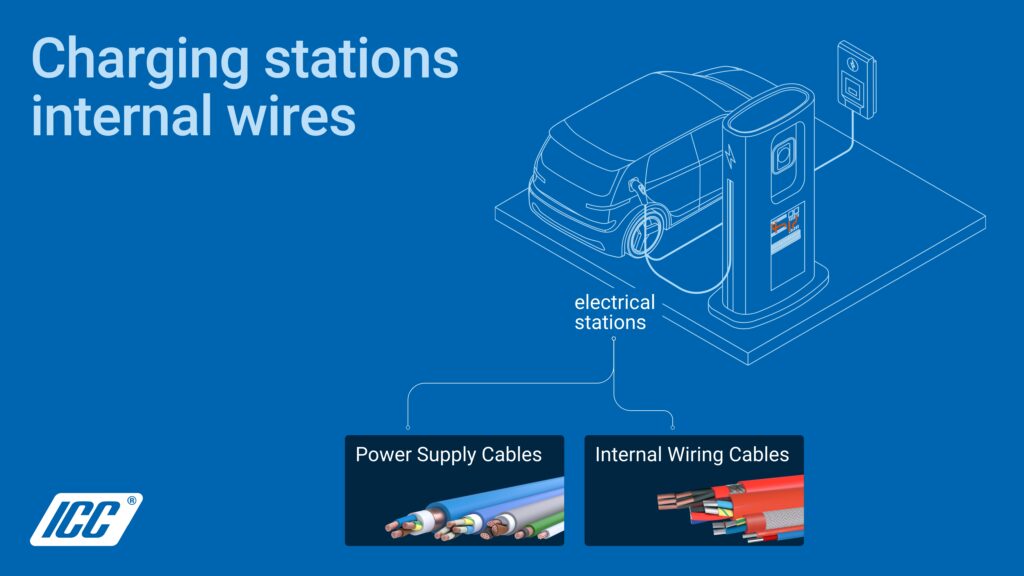
The quality and resistance of the cables used inside charging stations is essential to ensure safety and operational reliability. The cables connect internal components to charging stations, such as power supplies and control systems, and must be resistant to specific environmental and working conditions.
- Insulated with silicone, PVC, rubber, or special elastomers
- Usually halogen-free, flame-retardant, and low smoke (LSOH)
HIGH VOLTAGE CABLES IN HYBRID AND ELECTRIC VEHICLES
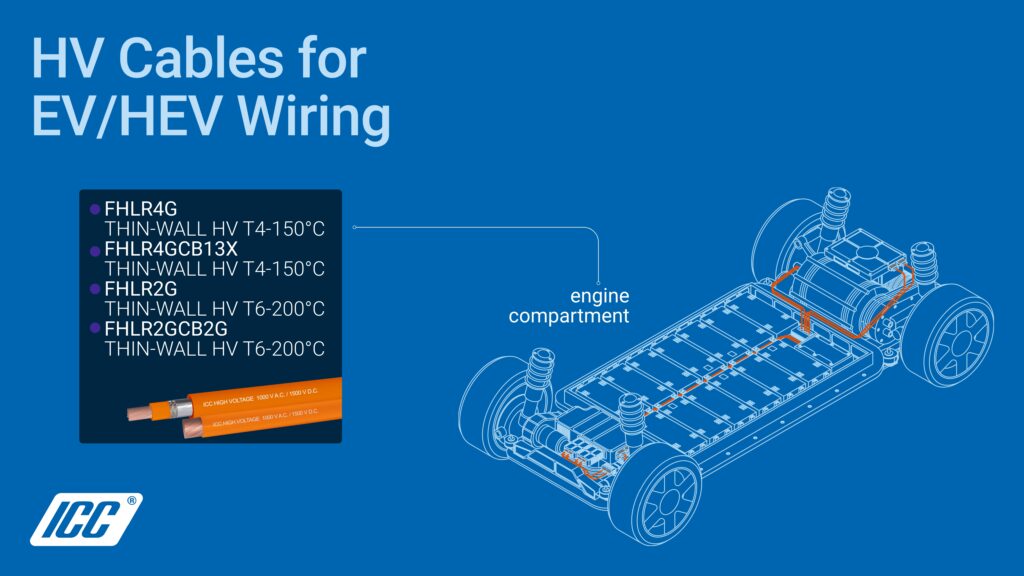
Inside electric vehicles, all high-voltage cables are easily recognizable even by non-experts thanks to their orange sheathing. They are designed to withstand electromagnetic interference, thermal stress, and mechanical stress. Shielded single-core HV cables are used between the HV battery, distributor, and motor. The most common cross-sections range from 16 to 70 mm² (light vehicles) up to 95 or 120 mm² (heavy vehicles). Other types of shielded multipolar cables are used for auxiliary components such as compressors, heaters, and plug-in sockets, with cross-sections ranging from 2.5 to 6 mm².
High-performance solutions: the HV range
FHLR4G & FHLR4GCB13X
- Nominal voltage: 1000 V AC / 1500 V DC – Operating temperature: up to 150°C (class T4)
- Silicone insulation, special elastomeric sheath
- Compatible with class F paints, ozone, UV, mineral oil. Excellent tear resistance, good resistance to most oils, chemicals, and weather conditions
- Ideal for motors, transformers, and HV power systems
FHLR2G & FHLR2GCB2G
- Rated voltage: 1000 V AC / 1500 V DC – Operating temperature: up to 200°C (class T6)
- Silicone insulation, silicone sheath
- Compatible with class F paints, ozone, UV, mineral oil. Excellent tear resistance, good resistance to most oils, chemicals, and weather conditions
- Ideal for motors, transformers, and HV power supply systems
All cables in the ICCxEV® range are halogen-free, flame-retardant, and low smoke emission.
Their compatibility with connectors from different manufacturers makes them extremely versatile in the design phase: for this reason, custom versions are also available and developed according to specific customer requirements.
